DTF vs DTG – Definition, Comparison and Areas of Application
DTF and DTG are revolutionising the world of textile finishing. We’ll explain the differences between DTF and DTG, outline their pros and cons, and show you which SECABO machines are best suited to which applications.
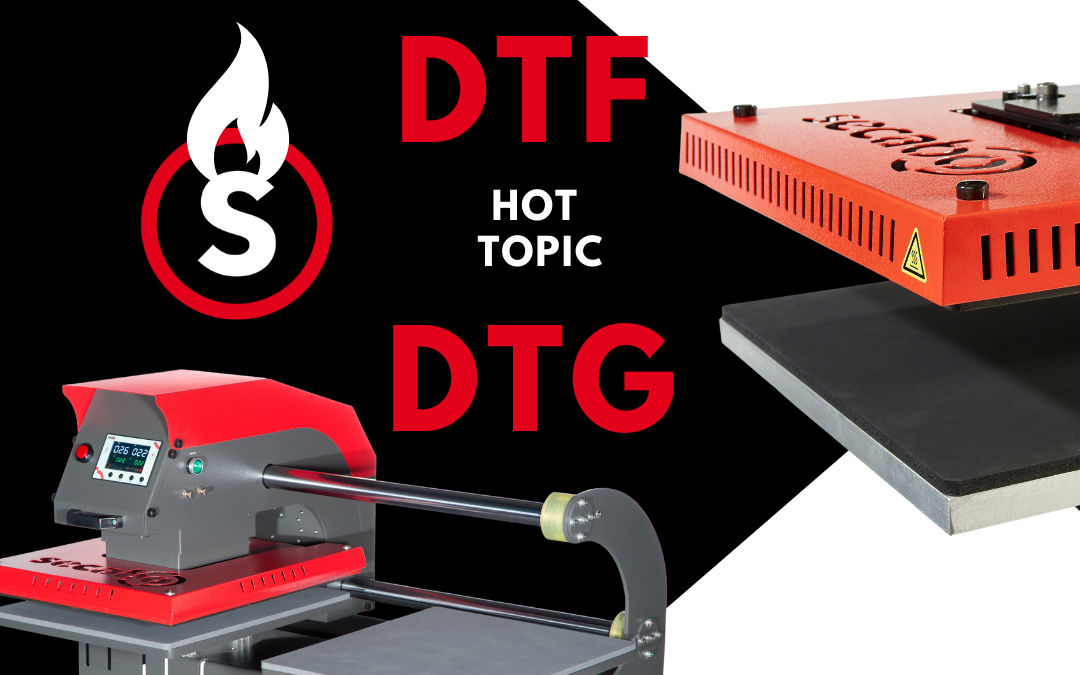
Hardly any other sector is as heavily influenced by trends as the textile industry. However, it is not only cuts, fabrics, colours and patterns that change rapidly; new developments in textile finishing are also shaping the market. The terms DTF (Direct To Foil) and DTG (Direct To Garment) are undoubtedly the most significant trends in the textile printing sector and could turn the world of textile finishing on its head in the long term.
Today, we’d like to explain the key differences, highlight the pros and cons, and outline which SECABO machines you can use for which purposes.
DTG– Print directly onto your textiles!
Definition & Procedure
The term ‘Direct-to-Garment’ (DTG) already gives a clue as to what this technology involves: the fabric is printed directly by a printer with the desired design.
Even more so than with other printing processes, great importance must be attached to the material and quality of the fabric. This is because the special ink is only durable on linen, cotton or, at most, 50/50 blends of cotton and polyester. In all cases, the textiles are treated in advance using a process known as pre-treatment. This is particularly crucial when printing on dark textiles with white ink. However, even light-coloured textiles should be pre-treated, as this prevents the ink from penetrating the fabric itself, thereby ensuring a brighter and more detailed design.
Once the textiles have been treated with the pre-treatment solution, they are dried in a heat press. To do this, the primer is first dried at approximately 180°C with some distance between the heating plate and the textile; after a brief cooling period, it is pressed again for up to 10 seconds at medium pressure. The exact parameters depend not only on the specifications of the pre-treatment and the fabric, but also on factors such as time, pressure and temperature. Both seeking advice from a professional supplier and experimenting to find the right approach are strongly recommended at this stage, as these steps play a crucial role:
The drying process creates an invisible film to which the ink adheres much more effectively. Furthermore, tiny vertical fibres are smoothed out by the pressing, resulting in an even more uniform finish. Professional equipment such as the Secabo TPD7 enables optimal results, as it provides the ideal conditions for drying thanks to its easily adjustable and reproducible pneumatic pressure and temperature settings. With its dual plates, the Secabo TPD7 also allows for parallel processing, thereby increasing throughput.
Following the drying process, the textile is printed with water-based ink using a digital printer. On dark textiles, a white undercoat is applied first, followed by the CMYK colours.
To permanently set the print, a transfer press is required once again. Alongside the Secabo TPD7, which is equipped with two plates, the Secabo TS7 smart transfer press is also an ideal piece of equipment for DTG processes. With its convenient, automatic swing mechanism and a base plate measuring 40 cm x 50 cm, it offers a particularly large working area for easy positioning of the items to be transferred, as well as a comfortable and even more flexible working experience.
Advantages of DTG printing
- Photorealistic and highly detailed designs
- No colour restrictions
- No high set-up costs as with screen printing
- Production of small and single-item runs at a consistent cost
- Outstanding texture, resulting in high comfort
- Very small quantities per design are possible, making it ideal for print-on-demand
- No time-consuming preparatory work, as is the case with screen printing, for example
- High reproducibility
- Wash-resistant, easy-care and durable prints
- Dark garments can be printed on
- Water-soluble, non-toxic and environmentally friendly inks
Disadvantages of DTG printing
- Not all materials are suitable
- All-over printing or printing on very large areas is not possible
- DTG printers and pre-treatment equipment are relatively expensive
- Not efficient for mass production and therefore not cost-effective
DTF – First onto the film, then onto the fabric!
Definition & Procedure
The Direct-to-Film (DTF) method follows the more traditional process that textile finishers are already familiar with from sublimationand foil transfers. In the case of DTF, too, a foil is applied to a textile using a transfer press – in a mirror-inverted image, as with sublimation. The production of the design to be transferred, in turn, bears similarities to the plastisol process familiar from screen printing.
The DTF ink is applied in a mirror-inverted image to a specially coated film using an inkjet printer. DTG printers can also be used for this process by employing DTF ink.
In the next step, a hot-melt adhesive is carefully sprinkled onto the ink whilst it is still wet. To allow it to gel and develop its adhesive strength, it is heated using a transfer press. As direct contact between the heating plate and the adhesive must, of course, be avoided, professional presses such as the Secabo THE BEAST are particularly suitable. The press head’s wide adjustment range allows for a gap of up to 7 cm between the base plate and the heating plate, whilst the combination with the TB7 Thermobase also provides heat from below, saving a considerable amount of time. In addition, the oscillating mechanism prevents the adhesive from being accidentally ‘knocked’ out of place or scattered.
Once the adhesive and ink have bonded, the design is applied to dark, light or coloured textiles made of cotton, polyester, elastane, blended fabrics or other materials using a transfer press. The passive membrane of the Secabo TC7 SMART MEMBRAN, used as a base plate, can be inflated using a small air pump, which helps to compensate for unevenness or differences in height in the transfer objects. As the heat is applied only where it is needed, the textile is also protected against resublimation or dye migration. In the case of DTF too, the manufacturers’ instructions for the film, adhesive and ink should be followed, and tests should be carried out on the specific textiles to determine the ideal pressing parameters for time, temperature and pressure.
Advantages of DTF printing
- Virtually all textile materials can be printed on, such as polyester, blended fabrics, sportswear, technical clothing, workwear, high-visibility vests, gym bags and caps
- Printing is possible on both light and dark textiles
- No pre-treatment required, unlike with DTG
- Transfers are stretchy, tear-resistant and washable up to 60 degrees
- Simple pre-production and storage of DTF transfers
- Less white ink than DTG
- More durable than DTG prints
Disadvantages of DTF printing
- PET films are relatively expensive
- Prints are clearly noticeable to the touch and do not feel smooth
The decision between DTG and DTF must be based on various factors, such as the desired production volume, the effort involved, the costs and the desired result. In both cases, however, purchasing a suitable transfer press is essential. Let our sales team provide you with personalised, tailored advice – send an email to mail@y-o-w.com or call us on 0800 9697467.