Textile printing: Optimal positioning of textile transfers
Printed textiles are both a fashion statement and an advertising medium. We explain how to position your textile transfer perfectly.
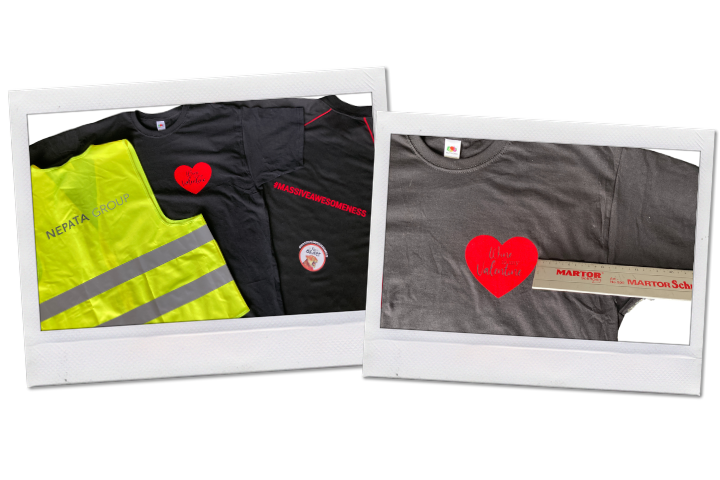
Printed textiles are not only a fashion statement, but also excellent advertising media. But whether for sales purposes or as uniforms for your own staff, the optimal transfer position must be found on the garment for every textile print. Although the position of the design can, of course, be chosen freely and tailored to your preferences, there are a few common tricks you can use to determine the perfect position for the desired transfer.
Centre front positioning on T-shirts
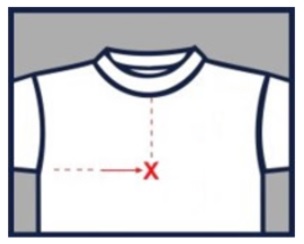
Based on a standard printed T-shirt, this rule of thumb can also be applied to similar tops. To determine the ideal central position, lay the T-shirt to be printed out flat in front of you. Now take a long ruler or folding rule and place it against the lower edge of the sleeve so that it lies horizontally against the opposite edge.
Now work out the horizontal centre by halving the measured distance and marking the relevant point on the T-shirt, directly above the centre of the ruler. Position your design on this point to achieve the best result.
If you wish to position the print design centrally at chest height, measure the centre of the two opposite sleeve edges again, but this time starting not from the bottom edge of the sleeve, but from the centre of the sleeve seam:
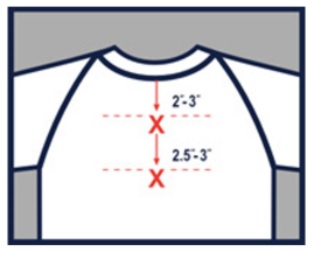
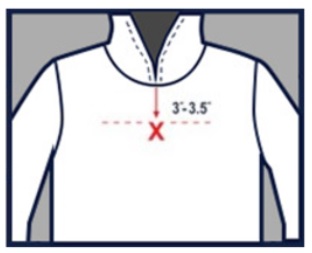
Left-hand/right-hand front positioning
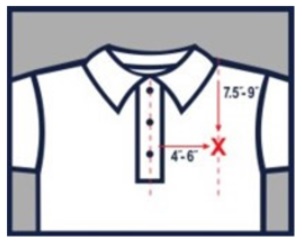
Smaller designs in particular, such as names or company logos, are often positioned on the left or right side of the chest. With polo shirts, on the other hand, it makes sense to print the design directly onto the breast pocket. For the optimal position on the left-hand side, take your ruler again and measure vertically downwards from the seam at the left-hand end of the collar by about 20 cm.
Mark the corresponding spot. To ensure you have found the optimal position, now measure vertically downwards from the centre of the collar by about 10–15 cm. Mark this point as well. Ideally, the ruler should now intersect horizontally with the point you marked first above the left breast.
Placement of the design on short-sleeved T-shirts
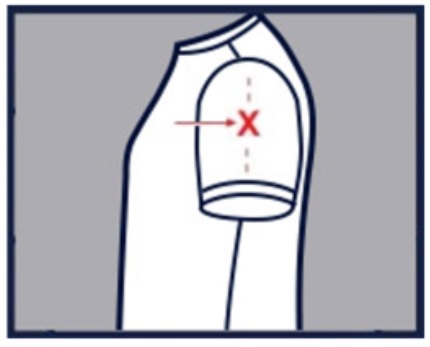
As well as front positioning, printing on the sleeve is also a popular method of textile customisation. To determine the perfect position for the design on a short-sleeved T-shirt, lay the T-shirt flat out in front of you again. Now use the top crease formed by the T-shirt sleeve as it lies spread out in front of you as a guide. Take a ruler and measure the length of the edge.
Mark the centre and use the fold line as the vertical centre. When worn, the printed design will now be positioned exactly in the centre of the corresponding sleeve.
Tools for positioning textile transfers
Particularly with larger print runs, determining the optimal print position on a case-by-case basis can take a great deal of time. Whilst the manual method has proved its worth for one-off orders or small print runs, it is advisable to purchase a cross-laser for transfer presses if you carry out frequent commercial textile printing. This also ensures that the print position is more precise than when done by hand and is perfectly identical for every item of textile in a series.