Adjusting the drag blade correctly
Blade holders fitted with drag blades are found in almost all cutting plotter systems. As a rule, the cutting depth of the blade must be adjusted via the blade holder, depending on the material. We know from experience that beginners to this creative technology often encounter problems when plotting because the blade is set too deep or not deep enough. However, the adjustment is quite simple and there are only a few – but important – points to bear in mind.
In the images below , the top material (e.g. adhesive film) is shown in red , the adhesive applied to the top material is shown in light grey , and the backing material (e.g. kraft paper) is shown in dark grey at the very bottom .
That’s too much
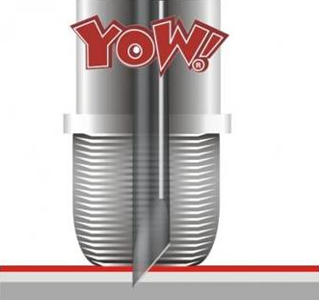
Blades set too low result in frayed corners during plotting and, overall, poor plotting results. Furthermore, the objects being plotted may fall apart inside the cutting plotter and block the blade head. If the cut is too deep into the backing material, the adhesive flows into these gaps and bonds with the kraft paper. The sticker then becomes almost impossible to peel off the backing, particularly after prolonged storage.
That’s not enough
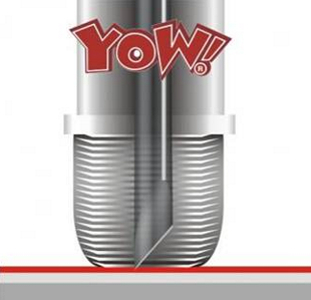
If the drag knives are set too flat, the material will not be cut completely and will be impossible or very difficult to weed. It is tempting to compensate for drag knives set too flat by increasing the cutting plotter’s contact pressure; however, this further deteriorates the plotter results due to the material being pushed around.
That’s right
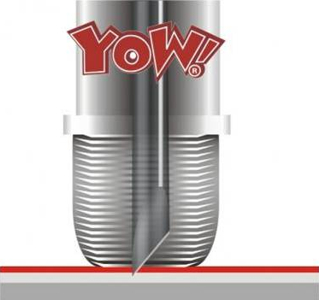
When plotting, the drag knife should cleanly cut through the top layer (adhesive film, flex film, etc.) and slightly score the underlying backing material. This means that, for a standard adhesive film 60µm thick, the knife must be set to a depth of approximately 65µm. This is roughly equivalent to the thickness of a human hair. If you can see the blade of your knife protruding clearly from the front of the blade holder, it is set too deep. A drag knife that is completely hidden within the blade holder is also incorrectly set.
You can very easily check whether the drag knife is set correctly by doing a quick test: if you run your finger gently over the blade holder, you should be able to feel the drag knife scraping very lightly against your fingertip.
Scoring the backing facilitates the subsequent repositioning of individual objects or, for example, the application of multi-coloured stickers.
What makes flock films special
The following should be noted regarding flock films: although these films are significantly thicker than flex films or standard adhesive films, they still require only a slightly greater cutting depth. This is because the flock fibres themselves are not bonded together and therefore do not need to be cut. Only the hot-melt adhesive layer needs to be cut through, which is usually no thicker than 100 µm. A slight increase in blade depth compared with adhesive films should therefore be sufficient to achieve an optimal result.