Modern Pricing in the Sign and Display Industry: Part 2 – Contribution Margin Analysis
In the first part of our series on cost calculations, we looked at full-cost accounting. Whilst this may appear at first glance to be the simplest method of calculation, it is also a very imprecise one. For example, wear and tear on equipment often has to be estimated – after all, who knows exactly when a new purchase will be necessary? Another problem with full-cost costing is that it does not take the company’s current capacity utilisation into account. If, for example, there is spare capacity, it may make sense to accept orders that would not be profitable under full-cost accounting. To better reflect reality in the costing process, contribution margin accounting is used much more frequently. This method distinguishes between fixed costs and variable costs.
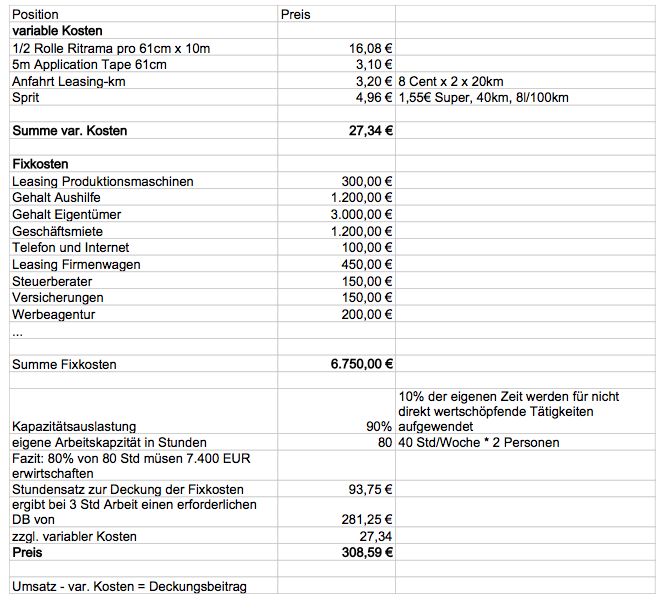
Fixed costs
Fixed costs are all costs that are incurred in any case, regardless of whether an order is processed or not. These include, for example, rent, salaries, lease payments and other contracts with fixed costs that cannot be easily reduced.
Variable costs
Variable costs are all costs associated with the production of orders and which are incurred only during active production. These include, for example, material costs, but may also be labour costs, such as when freelance staff are engaged on an hourly basis. These costs only need to be paid whilst the staff are actually working
Contribution margin
The contribution margin is the difference between turnover and variable costs. At the end of the month, this amount must be high enough to cover all fixed costs
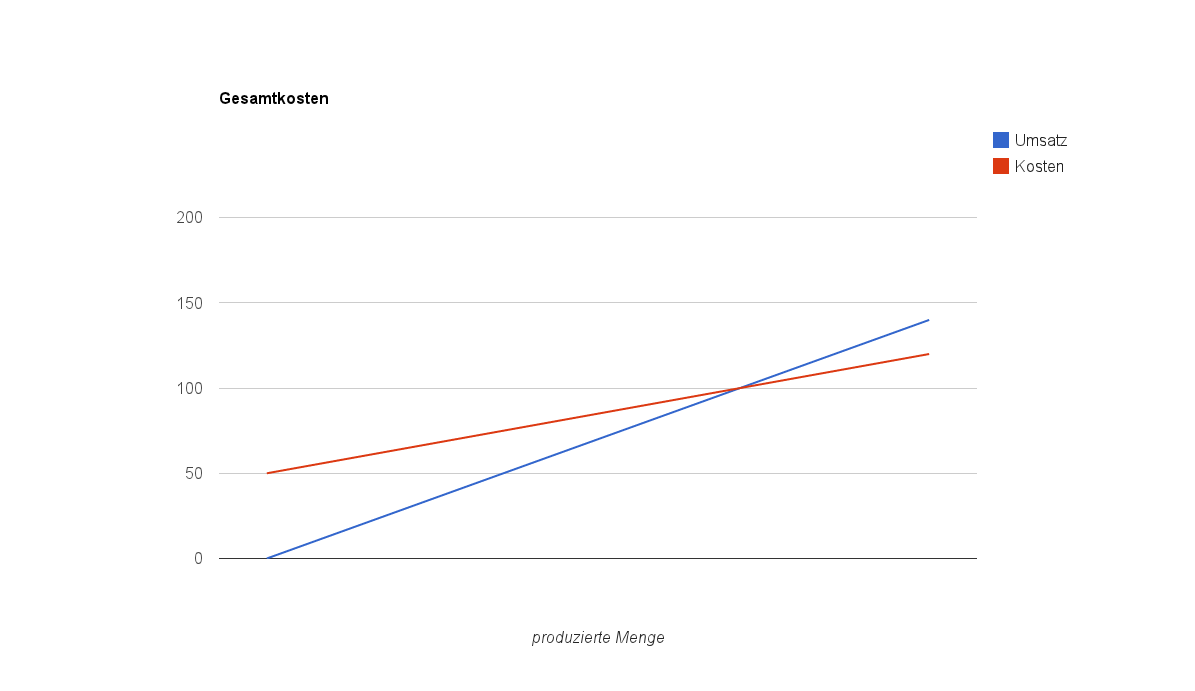
In the graph shown, total costs are plotted in red as a function of the quantity produced, whilst turnover is shown in blue. Even when production is at 0, fixed costs of 50 are still incurred. The point where turnover and costs intersect is the break-even point. It is only from this point onwards that the company makes a profit.
fixed costs
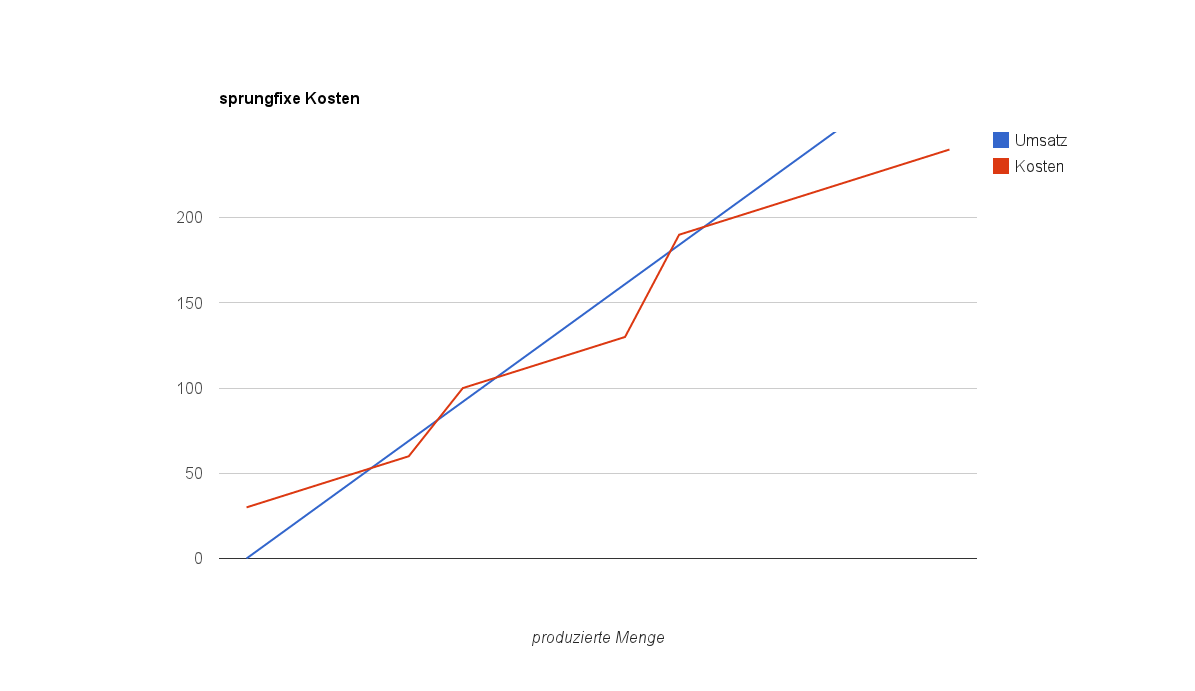
In practice, the quantity produced cannot be increased indefinitely without also increasing fixed costs. This occurs, for example, by taking on a new employee or renting larger business premises. Once a certain production volume is reached, fixed costs therefore usually rise sharply. These are known as step-fixed costs. The company is often operating in the profit zone at this stage, but is reaching its capacity limit. If this limit is exceeded even slightly, the step-fixed costs cause the company to slip back into the loss zone, and it is only when revenue increases sufficiently that the step-fixed costs are recouped.
Shifting costs between fixed and variable costs
As a rule, companies try to keep fixed costs as low as possible so that they can still generate a profit even in difficult times and react flexibly to changes. There are various ways of converting a limited proportion of fixed costs into variable costs, for example:
- freelancers who are paid by the hour, rather than permanent staff who must be paid regardless of their workload
- Car-sharing charged by the kilometre rather than a monthly leasing instalment for a company car
- Outsourcing of functions, e.g. an accountancy service provider that charges a fixed fee per invoice, rather than maintaining an in-house accounts department
- Service contracts for printers where charges are based on the number of pages printed, rather than a fixed leasing rate regardless of usage
Costs and investments
Generally speaking, investments (e.g. the purchase of a cutting plotter) are not classified as costs but are recorded as fixed assets. Such investments are usually depreciated for tax purposes over several years. This imputed depreciation must then also be included in the contribution margin analysis. You must decide for yourself whether to treat depreciation as a fixed cost or a variable cost. A cutting plotter that you replace with a newer model every four years is clearly a fixed cost, as it loses the same proportion of its value each month. The situation is different, for example, with a transfer press for mugs, where the heating sleeve is a wear part that needs to be replaced after a few thousand mugs. In this case, depreciation must be regarded as a variable cost dependent on the volume produced. For tax reasons, it often makes sense to utilise investments via leasing rather than as fixed assets. In this case, the investments effectively become expenses, which offers tax advantages on the one hand, and benefits in terms of liquidity and the balance sheet on the other. Due to what is known as ‘balance sheet reduction’, these machines do not appear under fixed assets, which reduces the total balance sheet total and thus increases the equity ratio. This ratio is important, for example, for banks when granting loans.
Profit and Contribution Margin
Generally speaking, it is important to realise that the contribution margin is not the same as the company’s profit. Company founders often think, ‘If I buy a product for €10 and sell it for €20, I’ve made a profit of €10’. In reality, this 10 EUR represents the contribution margin. Profit only appears at the end of the month, once all variable and fixed costs have been deducted from turnover.