Car Wrapping: Self-adhesive films for car wrapping
Car wrapping is a great way to give your car a new look. With YOW! car wrapping film, you can easily wrap your car yourself
Car wrapping is hugely popular amongst German car enthusiasts. There are many reasons for this: sometimes it’s to hide unsightly scratches in the paintwork, sometimes it’s for advertising purposes, and sometimes people simply want to stand out from the crowd with a personalised design. Applying self-adhesive film to the vehicle’s bodywork or individual parts has proved to be a great alternative to conventional paintwork. In the YOW! online shop, you’ll find everything you need for car wrapping.
A wide range of design options for amateur tuners and advertisers
Car wrapping offers countless design options. With a full wrap, the entire car is covered in film. If you fancy an eye-catching colour or have grown tired of your current one, you can give your vehicle a completely new look relatively quickly and easily. However, it’s also perfectly possible to wrap just parts of the car. For example, you can turn your car into a real eye-catcher on the roads by partially wrapping the wing mirrors, roof or bonnet, or give your small car a sporty look with racing stripes.
At YOW!, we offer a huge range of self-adhesive films for this purpose. Our cast, highly flexible films have been specially developed for 3D application and are therefore particularly suitable for car wrapping. You’ll be spoilt for choice, whether you prefer a trendy matt finish or a glossy look. Are you actually happy with the look of your car, but would like to protect the surface better? Then our transparent Ritrama stone-chip protection film is just the thing for you! Car wrapping also offers significant advantages for advertisers. With lettering film, you can apply customised advertising messages directly to your company vehicle. This allows you to achieve maximum visibility with minimum effort.
Benefits of car window film
Having your car wrapped is often the more cost-effective alternative to a paint job. As well as the price difference, car wrapping also offers further advantages. For example, car wrapping film reliably protects the original paintwork underneath from stone chips and scratches for up to six years. You don’t necessarily have to change the colour of your car; there are also transparent protective films available. If you want to replace the film, it can be removed very easily without leaving any residue. Not least, this significantly increases the resale value should you ever decide to part with your vehicle. Another advantage is that, whilst professional help is almost essential for a paint job, amateur car enthusiasts can apply the film to their car themselves with relative ease. All you need is a bit of manual dexterity and the help of a second person.
Wrapping your car yourself – Here’s how
You will need:
- Car wrapping film of your choice
- Degreaser
- Hot air gun
- Felt squeegee
- Bubble-piercing needle
- Cutter
Step 1: Clean the vehicle
Before you start the actual wrapping process, you should clean your car thoroughly. This is so important because even the slightest imperfections would show through the film later on. Furthermore, dust and dirt affect the film’s durability. It is best to use a special degreaser for this. We also advise against applying the film to a car outdoors, as it would be almost impossible to avoid dirt particles blowing in. Instead, choose an enclosed space such as a large garage or workshop with an ambient temperature of 20 to 25°C.
Step 2: Cut the film to size
It is not possible to wrap a car in one piece. You should therefore measure all the body panels individually and very carefully, so that you can cut the individual sheets of film as precisely as possible.
Step 3: Applying a wrap to the car
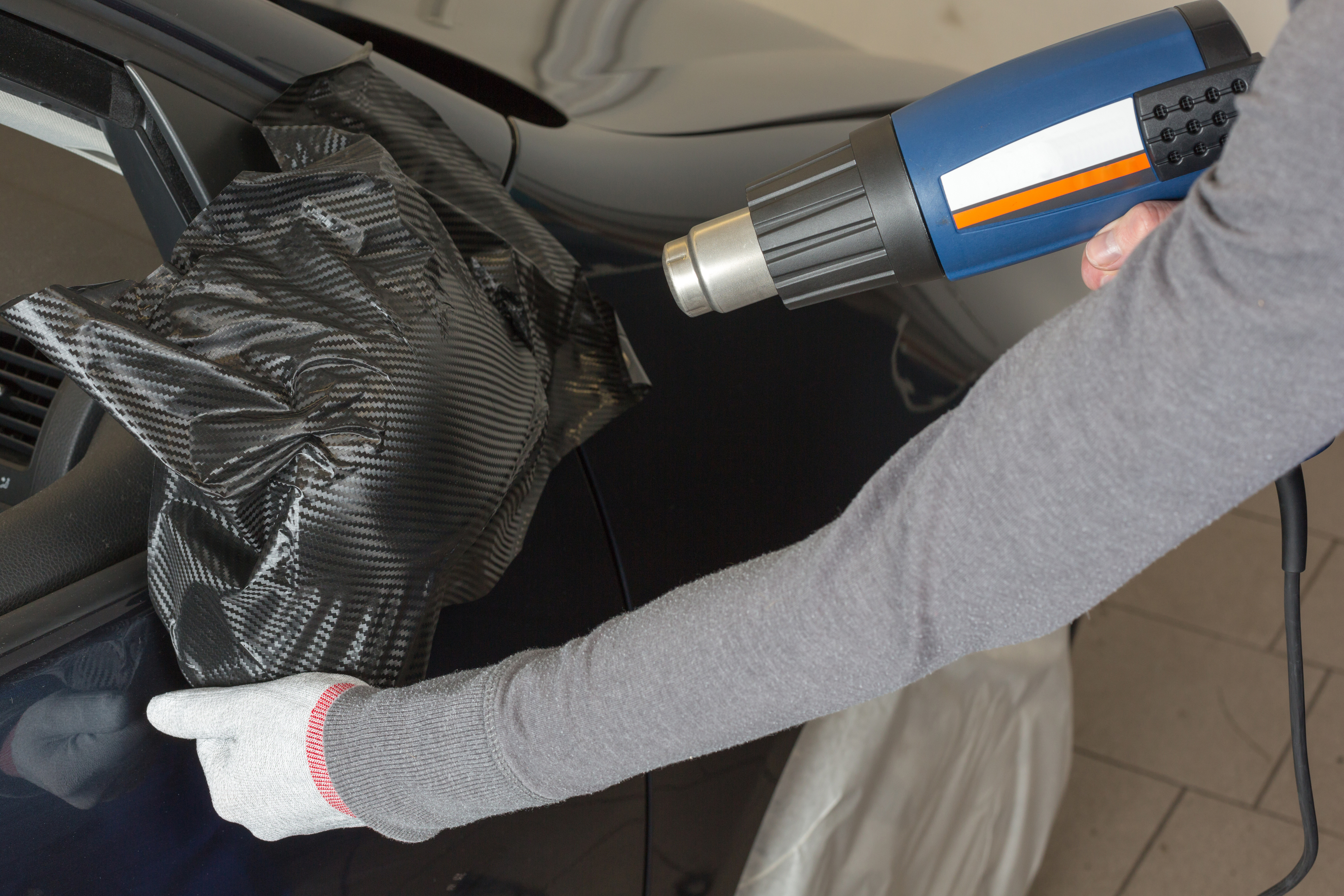
If you have no previous experience with car wrapping, you should start by applying the film to an area that is easy to work on. Peel off the protective film from the relevant cut-to-size sheet and position it centrally. Now work your way slowly from the inside out, applying a little more of the film at a time whilst applying heat with the hot-air gun. The felt squeegee will help you smooth out the film and ensure that corners and edges are neatly sealed. Ideally, one person should pull the film into the correct position whilst the other carefully applies it. Trim off any excess film neatly with a craft knife. Take particular care when doing so to avoid damaging the delicate original paintwork.
Step 4: Give your car a short break
Once the car wrapping has been successfully completed, you should allow your car a few days’ rest. During this time, any small air bubbles – which are almost impossible to avoid during the wrapping process – will usually disappear. Furthermore, the film will reach its full durability during this time and will then be ready for cleaning in a car wash. If a few small air bubbles are still visible, you can simply prick them with a fine needle.