
Pressure, cutting depth and cutting speed
To achieve the best possible results when working with a cutting plotter, it is important to select the correct settings for contact pressure, blade depth and cutting speed.
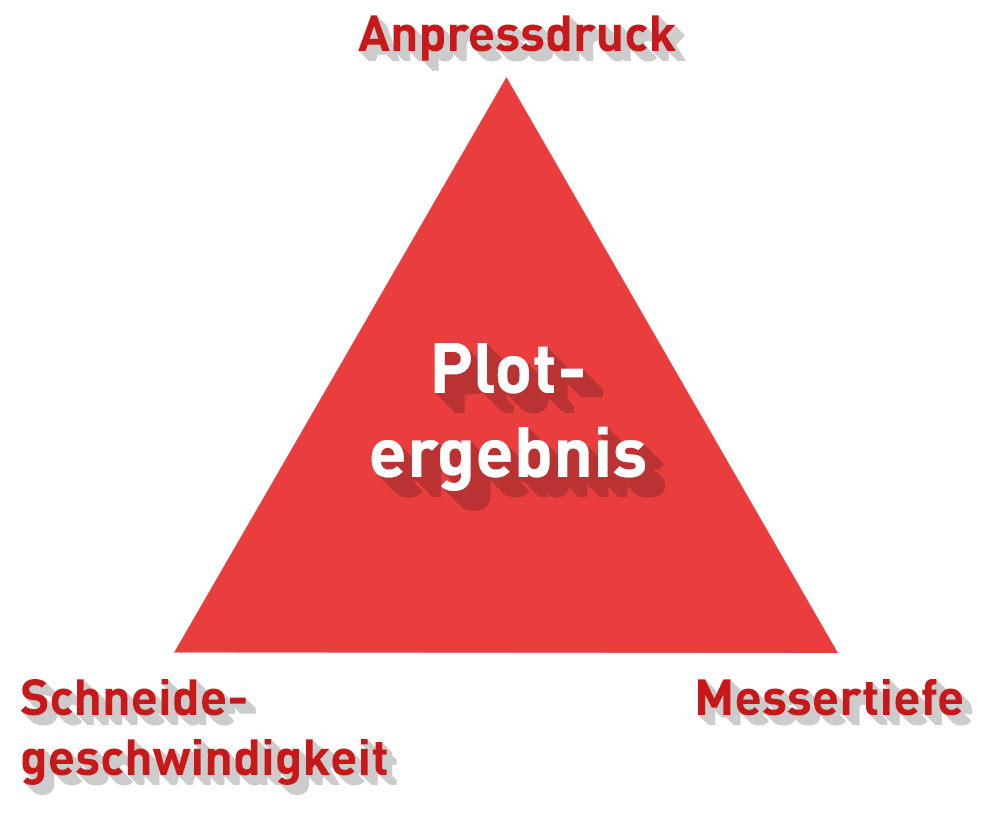
The diagram above shows that all three values are directly interrelated and it is therefore not possible to provide specific guidelines for each individual value. For example, if the cutter depth is too shallow, cutting can be carried out with greater down-pressure.
We nevertheless attempt to provide a certain adjustment range as a recommendation here, but generally always advise our customers to test the selected settings on the edge of the material being cut.
Self-adhesive films, adhesive films, plotter films, cutting films
- Contact pressure: 80g – 120g
- Cutting speed: 60% – 100%
- Cutting depth: thickness of the face material + approx. 20% (for an 80 µm adhesive film, this is approx. 96 µm or 0.096 mm – which is very little…)
Flexible films – standard polyurethane and similar materials
- Contact pressure: 100g – 140g
- Cutting speed: 60% – 100%
- Cutting depth: thickness of the face material + approx. 20%
Flexible films – thick and rigid types
- Contact pressure: 180g – 260g
- Cutting speed: 60% – 100%
- Cutting depth: thickness of the face material + approx. 20%
Flock films, thick and rigid flex films
- Contact pressure: 120g – 160g
- Cutting speed: 60% – 100%
- Blade depth: Only the thickness of the adhesive layer + approx. 50% allowance; not the thickness of the entire flock film!
Sandblasting films, cardboard and other thicker materials
- Contact pressure: 400g – 750g
- Cutting speed: 30% – 70%
- Cutting depth: thickness of the face material + approx. 20% (for a 60 µm adhesive film, this is approx. 66 µm)
It is also worth noting that the offset plays a role in achieving the best possible cutting result – with thicker materials, the offset of the blade decreases because it is not the tip of the blade that makes contact, but a specific point on the cutting edge. It may be worth experimenting a little with the settings here.
Further information on offset can be found here:http://blog.y-o-w.com/2009/11/20/schleppmesser-schneidwinkel-und-offset/